







| Home | Energy Physics | Nuclear Power | Electricity | Climate Change | Lighting Control | Contacts | Links |
|---|
Xylene Power Ltd. has a Certificate of Authorization issued by
Professional Engineers Ontario (PEO) and is professional liability insured.
THE BLUNT TRUTH ABOUT CO2
At the time of planet Earth's initial geologic formation, Earth's atmospheric CO2 concentration was very high and Earth's surface was volcanic (very hot). Water took the form of water vapour. Most rock consisted of metal silicates and there was no carbonate rock.
Over time Earth's surface cooled by net emission of thermal radiation into outer space. After Earth's surface cooled sufficiently to permit the existence of liquid water and carbonate rock, solar driven natural biological processes slowly reduced Earth's atmospheric CO2 concentration to about 280 ppm by sequestering CO2 in metal carbonate rock and in fossil fuels. Then for millions of years the atmospheric CO2 concentration stayed in the range 220 to 300 ppm and there was no net heat absorption because the thermal power absorption from solar radiation balanced the thermal power emission by infrared radiation.
In 1970 engineers became aware that the CO2 concentration in Earth's atmosphere was steadily rising due to large scale combustion of fossil fuels. This extra CO2 reduced infrared radiation emission by planet Earth causing measurable net heat absorption.
Today mankind burns fossil fuels at a prodigious rate to obtain heat and produces Portland cement by severe heating of metal carbonate rock. These two processes release CO2 to the atmosphere many times faster than natural processes are able to sequester CO2, causing an ongoing net rise in the atmospheric CO2 concentration and causing conversion of submerged insoluble carbonate rock [CaCO3] into water soluble bicarbonate ions [Ca(HCO3)2].
Calcium carbonate [CaCO3] is the main component of animal bones and marine shells. As the atmospheric CO2 concentration increases, insoluble CaCO3 exposed to water containing dissolved CO2 gradually becomes water soluble Ca(HCO3)2. Unless mankind stops combustion of fossil fuels, the increasing atmospheric CO2 concentration will gradually retard natural bone and shell formation, which will ultimately drive most large land animals and many marine species into extinction.
The increasing atmospheric CO2 concentration further reduces Earth's infrared emission which increases the atmospheric temperature, which in turn melts glaciers, polar ice and airborne reflective ice crystals that form white clouds. That ice melting decreases the planetary albedo (optical reflectivity) which further increases solar radiation absorption. Data gathered by the NASA CERES Satellites indicates that average net thermal power absorption by planet Earth has increased from 0.38 W / m^2 during the period 2000 to 2004 to 1.42 W / m^2 during the period 2022 to 2026.
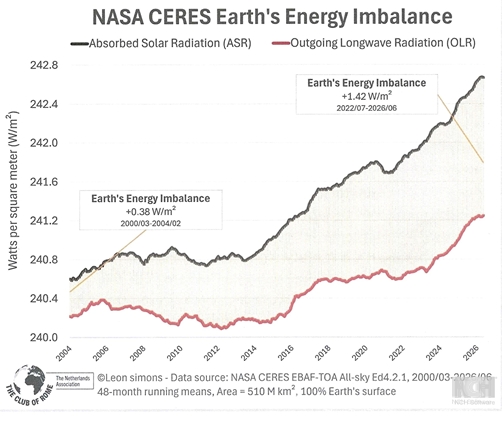
As compared to the ocean, dry land is a good thermal insulator. Hence, this thermal power is almost entirely absorbed by the ocean. Since the ocean area is about 2 / 3 of Earth's surface area, the net thermal power absorption by the ocean is about:
(3 / 2) X 1.42 W / m^2 = 2.13 W / m^2.
If this net thermal power absorption continues, which is almost certain, over a 50 year period the total heat absorbed by the oceans will become at least:
(2.13 W / m^2) X (50 years) X (8766 h / year) X (3600 s / h) X (1 J / W-s) = 3,360,884,400 J / m^2
Consider a column of water with a cross sectional area of 1 m^2 that extends from the ocean surface to a depth of 100 m. The mass of water in that column is:
100 m X 1 m^2 x 10^6 g / m^3 = 10^8 g
The average temperature rise in that column of water over 50 years is:
3,360,884,400 J X (1 cal / 4.18 J) X (1 g-deg C / cal) X (1 / 10^8 g) = 8.04 deg C
Note that this warm water will float on top of the denser cold water at greater depths. This 8 degree C ocean surface temperature rise will raise an existing tropical ocean surface temperature of 23 deg C to over 31 deg C. By comparison, a sustained wet bulb temperature above about 35 deg C is lethal to humans. This simple calculation shows that net heat absorption by planet Earth will, over the next 50 years, force mass human migration away from tropical countries towards more temperate countries. This forced migration of literally billions of people will have extremely dire consequences.
Isotopic analysis of ocean bottom drill cores indicates that in the geologic past, planet Earth experienced isolated periods (~ 200,000 years) of high atmospheric CO2 concentration, such as during the PETM (Paleocene Eocene Thermal Maximum), about 56 million years ago. The fossil record shows that during the PETM all large land animal life forms became extinct. That is the fate that awaits mankind within a few human generations if the atmospheric CO2 concentration continues to rise. The isotopic record further demonstrates that the time frame for natural processes to return the present atmospheric CO2 concentration to its 1970 level is of the order of 10,000 years.
If mankind is to continue to inhabit planet Earth, mankind must learn to live without combustion of fossil fuels and without severe heating of carbonate rock. It is necessary to replace energy presently obtained by combustion of fossil fuels with clean energy (renewable energy plus nuclear energy). World wide, the average thermal power output by fossil fuels is presently over 20,000 GWt and is trending toward 40,000 GWt. These thermal power values correspond to an average of about 2.5 kWt / person trending toward 5.0 kWt / person. Displacing the world consumption of fossil fuels requires over 10 kWt / person of sustained clean power in developed countries.
However, the CO2 displacement problem is even worse than indicated by the aforementioned thermal power averages. One of the difficulties is that the clean energy generation rate and the local energy consumption rate are both seasonal and are unequal. For example, in Canada the peak heating load in the winter can be as much as 6X the heating load in mild seasons. The economic way to meet this seasonal peak load is to store energy at mild outside air temperatures for later use at cold outside air temperatures.
Today, in Ontario, about 85% of total energy consumption is met by combustion of fossil fuels and about 15% is met by supply of electricity, of which about 90% is non-fossil. Typically each high rise residential suite has a peak sustained winter heating power requirement of about 5 kWt, potentially needs 1 kWe / suite for electric vehicle battery charging and needs 1 kWe / suite for non-heating loads. By comparison, today the functional and reliable clean electricity generation capacity in Ontario is only about 1.0 kWe / person.
If the clean energy required for fossil fuel displacement must be supplied by remote electricity generation the required increase in electricity system capacity is as much as 6X.
If the clean energy required for fossil fuel displacement can be supplied by an adjacent nuclear power plant (NPP), such that low grade heat rejected by thermal electricity generation is usefully used, the required increase in electricity system capacity is about 4X.
The projected clean energy requirements increase approximately in proportion to the population.
The biggest single obstacle to viable climate change mitigation is getting people to recognize:
a) The magnitude of the required increase in sustained clean electricity system capacity;
and
b) The advantages of adjacent nuclear power generation over remotely generated clean power.
Elected politicians, who usually have personal time horizons of less than ten (10) years, are presently unwilling to fund deployment of the fuel sustainable NPP capacity required to prevent further increase in the atmospheric CO2 concentration. The consequences of that funding refusal on future human generations are dire.
CARBON CAPTURE AND STORAGE (CCS):
Some politicians try to convince untrained voters that a technology known as Carbon Capture and Storage (CCS) will prevent significant further fossil fuel combustion induced rises in the atmospheric CO2 concentration, whereas in reality there is no physical basis for that assertion.
A problem with CCS (storing liquid CO2 underground at 1100 psia or 7.4 MPa) is that over time the CO2 will chemically combine with limestone (CaCO3) and ground water (H2O) to form high pressure Ca(HCO3)2. This Ca(HCO3)2, instead of being a solid, is a water solution that due to its pressure will tend to diffuse toward grade level along any limestone path. At grade level, due to the pressure drop, this water solution will release the dissolved CO2 back to the atmosphere. This process is similar to the release of CO2 to the atmosphere by an open soda drink. This CCS methodology might seem viable in circumstances where the storage location is very deep and where there is absolutely no carbonate rock. Those circumstances may exist at some depleted oil wells in volcanic rock, but in general are not true for the volumes of CO2 that must be stored to enable continued combustion of fossil fuels.
A major issue with large scale CCS is public liability. Over time, a CCS facility will form a large underground liquid CO2 reservoir with an overhead CO2 gas pressure of about 1100 psia (7.4 MPa). The liquid CO2 will remain trapped until the overhead high pressure CO2 gas finds a path back to grade level. That path might be along one of the original CO2 insertion pipes, perhaps enabled by an earthquake, thermal stress, long term corrosion or by an injection pipe seal failure. If this high pressure CO2 leaks quickly it will form an invisible ground hugging bubble of CO2 gas with a volume about 600X the volume of the liquid CO2 reservoir. This CO2 bubble will be lethal for any person or animal caught in it and will prevent human escape via vehicles powered by internal combustion engines. Each such CO2 reservoir will be a public liability insurance risk extending many centuries into the future. The present value of the associated stream of public liability insurance premiums will likely exceed the cost of simply avoiding CO2 formation via appropriate use of clean energy. Readers are reminded of the billion dollar funding shortfall at Lac-Megantic due to insufficient public liability insurance for the fossil fuel risk.
CLIMATE CHANGE MITIGATION REQUIREMENTS:
The astrophysical mechanisms of CO2 driven climate change have been understood by astrophysicists and engineers for decades.
Precise analysis of air bubbles trapped in old glacial ice has shown that the atmospheric CO2 concentration has been rising since the dawn of the industrial revolution, from an initial value of about 280 ppm to about 430 ppm today. Most of this concentration increase has occurred during recent decades. Today we can reasonably project an atmospheric CO2 concentration of over 560 ppm by the year 2070.
Practical experience with submarines and space craft has demonstrated that humans function best in an atmosphere with a CO2 concentration less than 1000 ppm. By this measure humanity only has about 100 years to totally abandon fossil fuels.
One of the consequences of CO2 driven climate change is ongoing net heat absorption by the oceans, which causes a gradual increase in dry and wet bulb temperatures. The increasing dry bulb temperature reduces Earth's planetary albedo (solar reflectivity) increasing heat absorption, while the increasing wet bulb temperature reduces the ability of plants and animals to cool themselves by evaporation of water (perspiration) and promotes violent storms. Soon many tropical countries will become uninhabitable without nearly continuous irrigation and air conditioning. Absent sufficient ground water, fields and forests soon become wildfire hazards.
In Canada, during recent years, climate change has caused record high temperatures, insect infestations, wildfire damage, violent storm damage, glacier and permafrost melting, sea level rise and ocean acidification. The climate change consequences in the USA, Europe and elsewhere are comparable. If the present fossil fuel consumption trend continues, the resulting thermal apocalypse will eventually drive large land animal life on planet Earth into extinction.
Preventing further increases in atmospheric CO2 concentration requires supply of sufficient economic clean (non-fossil) power that fossil fuels are preferentially left in the ground.
The law of conservation of energy indicates that preventing a further rise in the atmospheric CO2 concentration today will require sufficient additional economic, firm and sustainable clean power to displace the 21,000 GWt of thermal power that are presently being supplied by combustion of fossil fuels.
Few people appreciate the full range of application of fossil fuels. Electricity generation typically accounts for only 15% to 20% of the total fossil fuel consumption. Hence, displacement of fossil fuels presently used for electricity generation is only a fraction of the total CO2 emission reduction problem. Full displacement of fossil fuels requires about a 12 fold increase in both intermittent renewable power generation and firm nuclear power generation.
Due to seasonal, geographic and short term variations in renewable power generation and due to high transmission costs, lack of seasonal energy storage and lack of moment of inertia, renewable energy sources cannot provide firm power. Fuel sustainable nuclear power is required to economically meet the baseload.
AEROSOLS:
Due to political intransigence with respect to large scale deployment of sodium cooled fast neutron reactors and related nuclear fuel reprocessing, a heating relief measure that might be adopted by one of the major powers is to inject a sulfur based aerosol into the upper atmosphere to temporarily increase the planetary alabedo, which would reduce visible solar power absorption. However, this measure is fraught with risks and potential problems. The aerosol will affect different plant and animal species in different ways. The aerosol will reduce solar voltaic panel output. The aerosol will require expensive sustainment for centuries into the future.
The aerosol will affect rainfall distribution. While one country may benefit, another country may experience a drought and yet another country may experience floods. The resulting agriculture failures could easily lead to a world war. The costs of producing, controlling and sustaining the aerosol for centuries into the future are not small. Who would pay? Who would compensate countries that are negatively affected? It would be wiser to direct the same public resources to widespread deployment of sodium cooled fast neutron reactors that provide certain continuing climate change mitigation at a known cost.
THE MORAL COLLAPSE OF MODERN HUMAN SOCIETY:
As indicated by stone structures and writing from ancient Egypt, organized human society has existed for over 6000 years, or more than 240 human generations. In almost all of those generations, older humans believed that they should do all necessary to ensure the survival and prosperity of their descendants. Unfortunately, since about 1970, there has been a collapse in this belief. Today many older humans choose to save money now through use of fossil fuels instead of investing in the sustainable nuclear power systems necessary for survival of their descendants. If this trend in human behavior continues, the rising atmospheric CO2 concentration will drive humans into extinction within a few more human generations.
Unfortunately, a similar selfish thought pattern also pertains in the nuclear engineering community, where many engineers choose to deploy less expensive and much less fuel efficient thermal reactors now, rather than deploying more expensive but much more fuel efficient fast neutron reactors (FNRs). Proper application of FNRs would conserve the world's limited economic natural uranium resource for use by future human generations.
This is a sad observation about modern human society.
This web site quantitatively addresses the physical measures necessary to preserve future human life on planet Earth. It remains to be seen whether human society is willing to face the physical facts and act with sufficient vigor to prevent a human species collapse caused by a high atmospheric CO2 concentration. At the root of this matter is both insufficient public education in the physical sciences and insufficient public respect for senior engineers who have relevant knowledge and experience.
FOR DETAILS ABOUT THE SUBJECTS OUTLINED HEREIN PLEASE VISIT WEB PAGE HOME-2
This web page last updated October 14, 2026.
| Home | Energy Physics | Nuclear Power | Electricity | Climate Change | Lighting Control | Contacts | Links |
|---|